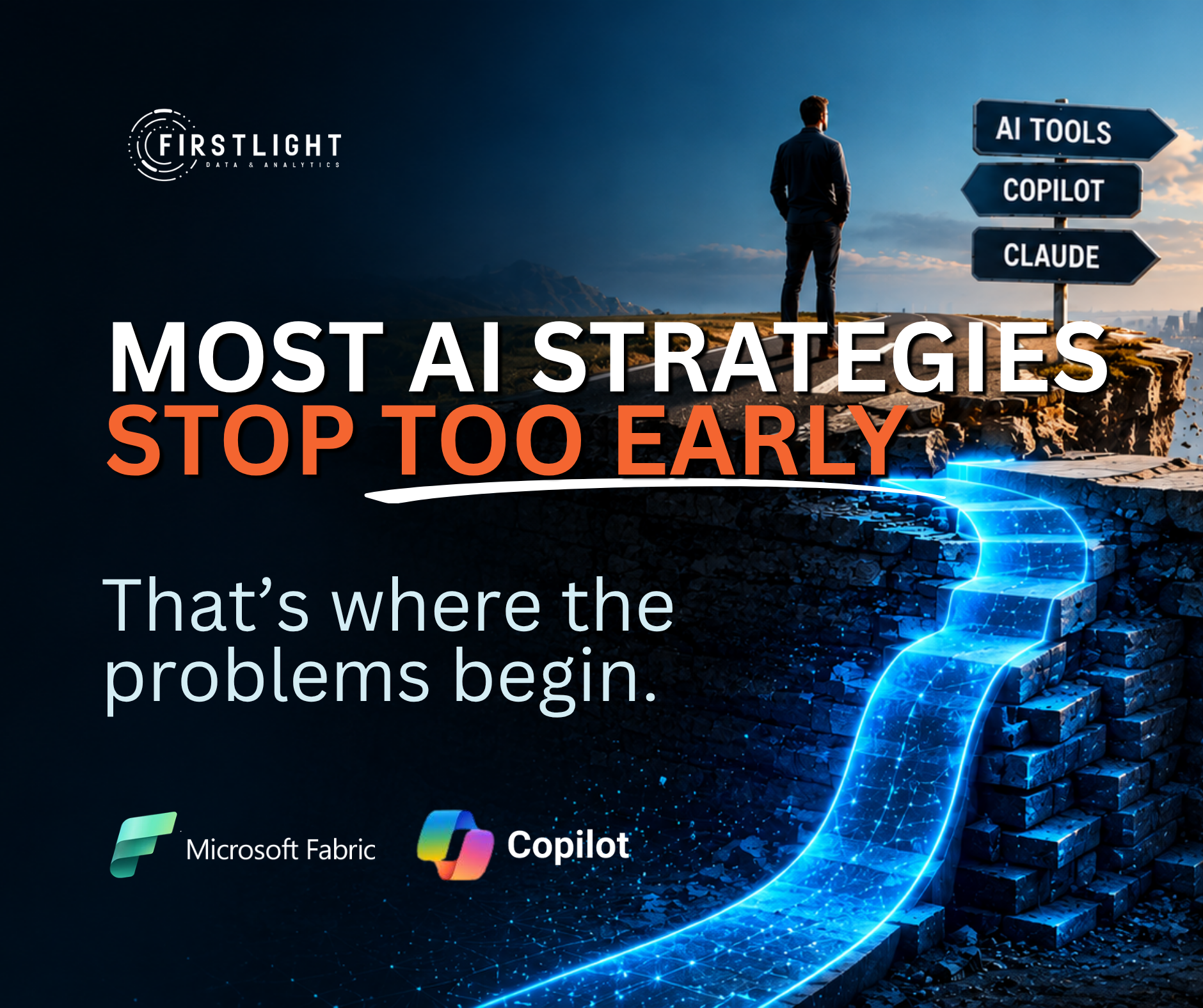
Most organizations reach a moment in their AI journey that feels like “done”. Licenses are active, employees are using Copilot, a few early wins made it into the quarterly update, and leadership checks the box and moves on. It's a natural response to a visible milestone, but what looks like the finish line is actually closer to the starting gun. The tools are live, but the work that determines whether AI creates lasting value or quietly creates new problems hasn't started yet.
The first layer of AI investment is the one most organizations know. It's AI applied directly to the work employees already do. Summarizing emails. Drafting documents. Building Excel models. Generating presentations. For power users, it goes further: reusable workflows, lightweight applications, API integrations that pull in data from internal systems.
This layer works. It delivers immediate productivity gains, amplifies skilled employees, and creates reusable knowledge that spreads across teams. It's also relatively simple to deploy. Licensing, configuration, a bit of training, and you're off. The ROI is fast and visible, which is exactly why leadership tends to declare victory and move on.
There's nothing wrong with Layer 1. The problem is treating it like the whole strategy.
Here's what happens when individual AI investment runs without an enterprise layer underneath it.
Users start building. They connect AI tools to whatever systems they can reach. They write queries against the ERP. They pull data from sources that were never designed to handle that kind of load from data that’s modeled six different ways. Each individual solution looks fine in isolation. Employees are getting reports they never had before. Productivity is up. Everyone is happy.
Meanwhile, the systems underneath are quietly degrading. The ERP that was already slow is getting slower. Queries are inefficient, misunderstood by the AI, or hitting tables in ways the original architects never anticipated. Failures don't show up at rollout. They show up six months later, when the load has compounded, and the source of the problem is nearly impossible to trace. And you really know it when your internal business customers are stopping by the desks of our already busy staff saying, “can you help me figure out this code?”
This is what technical debt acceleration looks like in an AI context. Every ungoverned solution built on top of a weak system makes the next failure more likely and harder to diagnose.
Individual AI investment alone doesn't just miss the opportunity. It can actively make the organization's data infrastructure worse over time.
Layer 2 is infrastructure, governance, and shared systems. It's less visible than Layer 1 and harder to show in a demo, which is exactly why it gets skipped. But it's what determines whether AI scales safely or collapses under its own weight.
It has five components worth understanding:
.png)
Without the enterprise layer, individual AI tools fragment. They drift in quality as the people who built them move on. They introduce system risk that nobody is monitoring. They get abandoned when something breaks, and there's no documentation to explain how they worked.
With the enterprise layer in place, individual AI productivity accelerates. Solutions become reusable. The data foundation absorbs workloads that would otherwise hit fragile systems directly. Token costs drop as more of the processing moves to structured data infrastructure rather than running through the AI model itself. Vibe-coded solutions are simpler because data has already been served in an intuitive model.
Enterprise investment doesn't slow AI down. It multiplies what an individual investment can actually produce.
The result is a flywheel. The enterprise layer reduces friction for individual contributors, which means they build better solutions faster. Those solutions feed back into the shared catalog, which makes the enterprise layer stronger. Each layer makes the other more effective rather than competing for the same budget and attention.
Most organizations are one layer into a two-layer problem. The tools are live, the employees are using them, and the technical debt is accumulating in ways that won't be visible until they're expensive to fix.
AI isn't one-and-done. Stopping at tools doesn't complete the strategy; it starts the risk. The organizations that get lasting value from AI aren't the ones that moved fastest in year one. They're the ones who built the enterprise layer before the sprawl made it impossible.
Your company can go from tentatively wading in the AI kiddie pool to doing the butterfly stroke in own backyard AI oasis; they key is to make your data clean enough to swim in! FirstLight can help you create meaningful, sustainable wins with AI.




.png)

.png)
.png)



.webp)